
How Alabama Custody Ends
A release record begins with the agency that had custody. Alabama county sheriffs and municipal departments process local jail exits, including bond, time served, dismissal, a court-ordered release, or transfer. ADOC handles sentenced state prisoners. Federal Bureau of Prisons and immigration custody use separate federal systems. A person may leave one roster and enter another agency's custody, so the phrase Alabama released inmates must be tied to a destination as well as an exit.
Release and discharge are not always the same. Parole and mandatory release place a person outside prison under supervision. A split sentence may lead from confinement to probation. End of sentence can complete the custody term, yet a separate court matter, detainer, or supervision term may remain. The record should name the release type rather than reducing all outcomes to “free.” A live jail roster is a present-custody list. Once a person leaves, the lasting proof is usually a booking or release document, an ADOC record request, a court order, a parole result, or another agency's record.
The official ADOC home page identifies the statewide prison authority.

That agency layer applies to state sentences, not to every person released from an Alabama county jail.
Alabama Release Types Compared
Alabama's own statistics separate release events by legal path. That distinction also tells a reader where to seek proof. A county release may be shown in the sheriff's booking system or obtained from the records unit. An ADOC exit requires state records. A favorable parole decision is held by the Board, but it does not establish the date ADOC completed the physical release.
| Release type | Meaning | Next record source |
|---|---|---|
| Bond or court release | Local custody ends under a bond or judicial order | County jail record and court docket |
| Time served | The ordered confinement has been credited or completed | Releasing jail or ADOC and the sentencing court |
| Parole release | Conditional release follows a Board grant and release processing | ABPP result, ADOC exit record, and field office |
| Split sentence | A confinement portion may be followed by probation | Court judgment, custody agency, and ABPP office |
| Mandatory release | An eligible state prisoner moves to a statutory supervision period | ADOC, VNS, and ABPP |
| Transfer or detainer | Custody changes hands rather than ending | Sending and receiving agencies |
Under Ala. Code § 15-22-26, parole is discretionary conditional release. Section 15-22-26.2 separately governs mandatory release to supervision. Neither category should be mislabeled as final discharge from all legal control.
Alabama Release Record Fields
No single statewide form represents every county jail and every prison. Still, a useful request asks for the same core facts. At the county layer, booking number and jail release details are central. At the state layer, the six-digit Alabama Institutional Serial number, called an AIS, helps ADOC locate the person. The source and field label must be preserved because a Minimum Release Date is not an actual Release Date.
| Field | What it establishes |
|---|---|
| Full name and identifier | Connects the document to a booking number, AIS, federal register number, or A-number |
| Release date | The recorded date custody ended at the named agency |
| Release type or reason | Bond, sentence completion, parole, split sentence, mandatory release, transfer, or another coded event |
| Releasing facility | The jail, prison, or office responsible for the exit record |
| Receiving authority | Shows when an apparent release was actually a transfer or detainer handoff |
| Supervision | Identifies parole, probation, or mandatory supervision when recorded |
| Case and sentence data | Connects the custody event to the court disposition |
The Alabama Just One Look portal provides a separate route to trial-court case and order history.
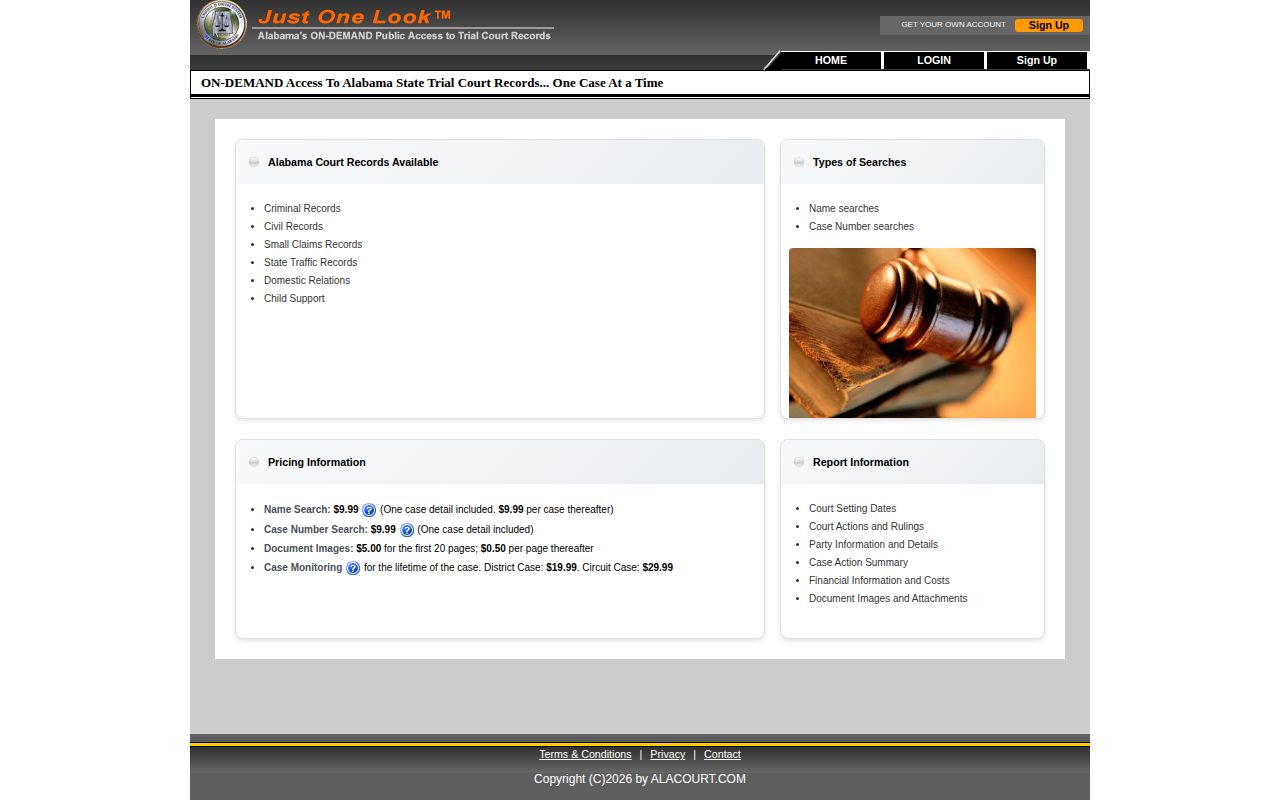
A court order can explain why release was authorized, while the jail or ADOC record shows how and when custody processing occurred.
Request Alabama Release Records
The request route depends on custody. For a local booking, identify the county and ask that sheriff or jail records custodian for an existing booking and release record. The Alabama County Directory routes all 67 counties to their local release sources. For a state sentence, ADOC requires Form 23-A and limits access under its regulations and Alabama law. Federal and immigration requests stay with the responsible federal agency.
- Identify the custody agency, facility, full name, stable identifier, and a narrow date range.
- Ask for the existing release date, release type, releasing location, receiving authority, and releasable discharge document.
- For ADOC, submit Form 23-A with the Alabama-residency attestation, preferred format, and nonrefundable $20 processing fee.
- Ask for clarification when a code could mean transfer, mandatory supervision, parole, or sentence completion.
- Match the agency response with the relevant court or supervision record when the custody exit remains unclear.
ADOC lists its Public Records Coordinator at public.records@doc.alabama.gov and 334-353-3883. Mail goes to Alabama Department of Corrections, P.O. Box 301501, Montgomery, AL 36130-1501. A focused request may name Form CREC 047, also called the C-80, when seeking the state-prison release receipt. Controlled or confidential material may be withheld or redacted, and an agency need not create a record that does not exist.
Note: Ask for a defined record and date range; a broad demand can slow review or require clarification under Alabama's request process.
Alabama Release Records Law
Alabama's Public Records Law makes public records requestable, subject to agency procedures, exemptions, fees, and lawful redactions. Act 2024-278 took effect on October 1, 2024. It formalized standard and time-intensive request tracks, acknowledgment and response stages, clarification rules, and an Alabama-resident-centered enforcement framework. A standard request generally takes less than eight hours of staff time, but that description is a category, not a promise of delivery by a set date.
Key Alabama rules: Ala. Code §§ 36-12-40 through -47 govern public-record access. Act 2024-278 sets the modern request process. Section 12-21-3.1 treats law-enforcement investigative reports and material as nonpublic.
Booking and release information is not the same as a full investigative file. Juvenile matters, sealed material, expunged records, privileged content, and safety-sensitive information may be restricted. No current official Alabama Code provision was located that requires mugshot publication or creates a specific anti-pay-to-remove rule. An official historical booking image should therefore be requested from the proper custodian under the general records framework, without relying on commercial mirrors.
Alabama Release Counts Differ
ADOC's April 2026 Monthly Statistical Report illustrates why terms matter. It records 874 jurisdictional releases: 108 end of sentence, 102 parole releases, 326 split sentence, 157 mandatory release, and 181 other. The same report separately lists 411 releases from ADOC custody and 65 paroles granted. Those measures answer different questions. Jurisdictional counts cover legal responsibility, while physical custody counts track exits from ADOC facilities.
Through seven months of fiscal year 2026, ADOC reported 5,487 jurisdictional releases, 2,385 custody releases, and 395 parole releases. April's jurisdictional total rose from 843 in April 2025 to 874 in April 2026, yet the comparable fiscal-year total remained lower than the prior year. The accurate reading is mixed. One favorable Board decision or one monthly total cannot establish a particular person's release date.
The ABPP current-year results show decisions apart from ADOC custody processing.
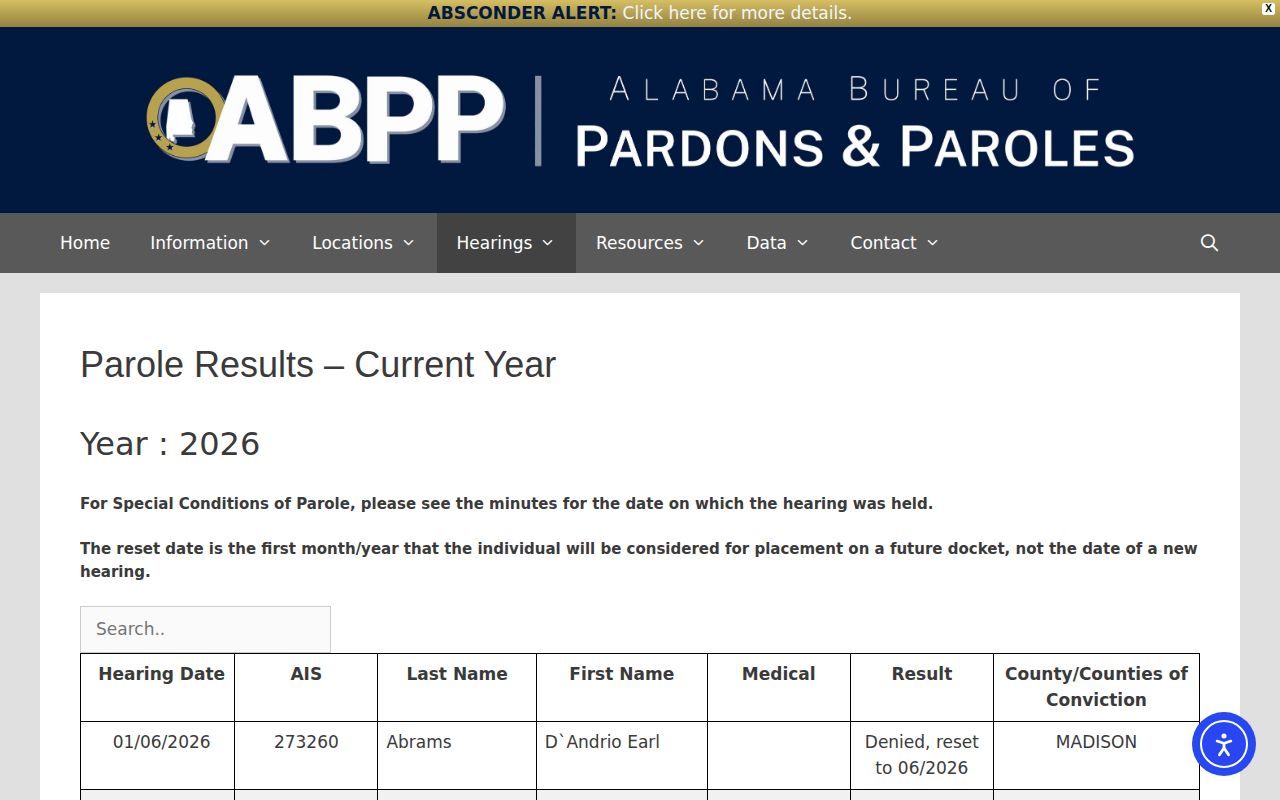
A result marked Granted is decision evidence; ADOC release documentation is still needed to confirm the physical exit.
Search Alabama Released Inmates
A defensible statewide search is a chain, not a single name box. Start with the identifier that matches the system. A booking number belongs to a county jail, a six-digit AIS belongs to ADOC, a federal register number follows the `#####-###` pattern, and an A-number belongs to immigration custody. Keep the exact name, case number, booking date, and last known facility before a live record disappears.
- Check the last known custody agency while the person may still appear in its current roster.
- If a county jail held the person, obtain that county's release or transfer record.
- If ADOC held the person, save the current fields, then request historical release documentation after the profile disappears.
- Use ABPP for parole decisions or supervision routing and the court docket for the judicial basis.
- Use BOP for federal custody or ICE ODLS for immigration custody, then reconcile any transfer between systems.
Important: A person missing from a current roster is not proven released. The person may have transferred, the name may differ, or the source may have updated.
The search ends only when a dated agency record explains the exit. When records conflict, preserve access dates and report the narrower fact. “Not returned in ADOC's current-only search” is sound. “ADOC discharged the person” is not sound without a historical release record.
ADOC Search After Release
The ADOC Inmate Search contains only people who are currently incarcerated. It is not an archive of Alabama released inmates and does not preserve a public Released or Discharged profile. Search by AIS when known because that value overrides the name fields and returns an exact match. Otherwise, first name and last name can be searched separately or together, with output limited to 50 records. Youthful Offender Act cases are excluded.
| ADOC field | Use and limit |
|---|---|
| AIS number | Unique six-digit identifier; exact match and strongest key |
| First and last name | Open-ended fields; spelling and result limits can affect the return |
| Institution and status | Current custody information that may vanish after release |
| Minimum Release Date | Earliest scheduled release to probation or end of sentence, subject to change |
| Parole Consideration Date | Tentative Board date, not an exit promise |
| Good time and time served | Separate sentence-computation fields, not a public calculator |
For the complete current-only limitation and records fallback, use the ADOC offender search deep dive. Constituent Services handles individual-inmate questions, while Central Records can address historical documentation. A specialized released-sex-offender link is not a general released-inmate archive.
Alabama Dates Can Move
ADOC Regulation 628 defines a Spontaneous Release as an exit before the scheduled Minimum Release Date after ADOC receives a court order, amended transcript, or parole-status change. Detainers and pickup arrangements can affect processing. This Alabama-specific path shows why a projected field saved yesterday may not match the later custody event.
The ABPP scheduled-hearings table supplies a rolling decision calendar.
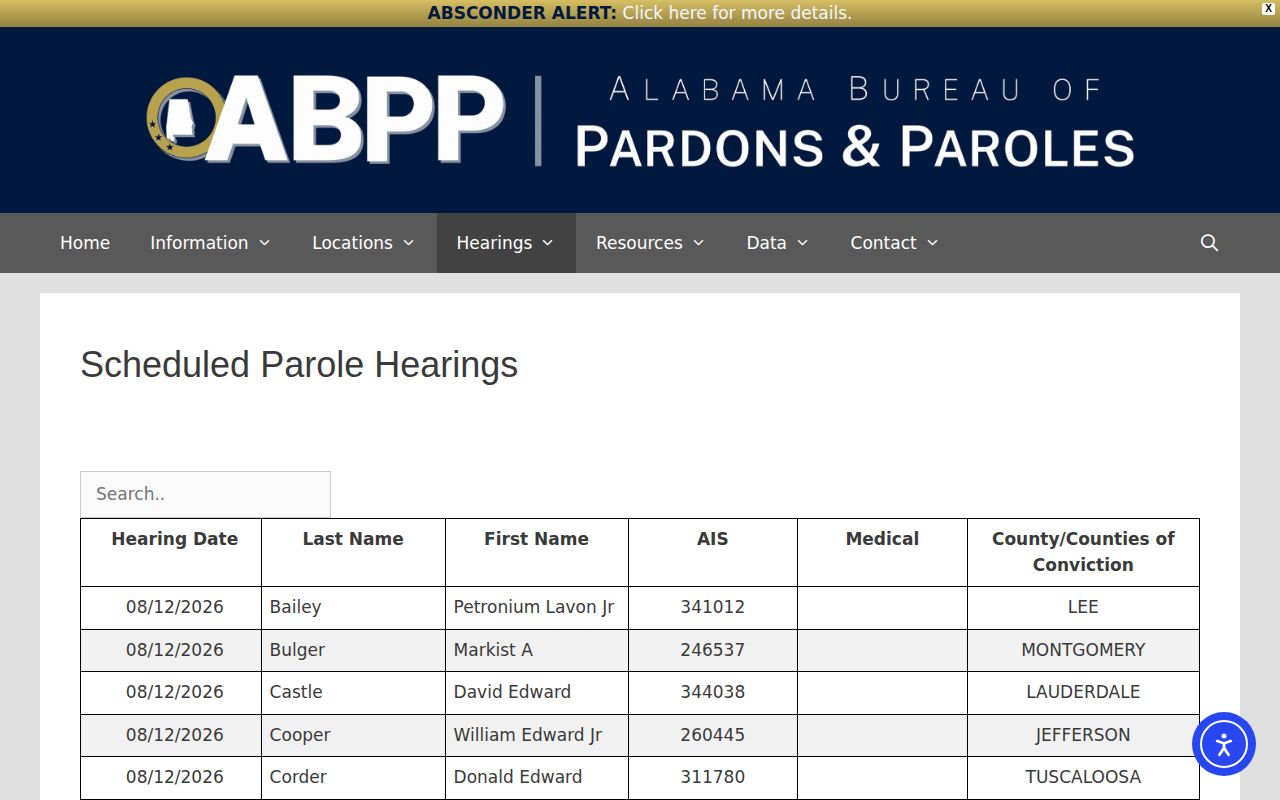
A scheduled hearing is one step in the process, not a guaranteed release day, and the table should be rechecked for changes.
Alabama County Release Search
County jail records cover local arrests, pretrial detention, short sentences, and transfers. The state has no single sheriff roster that preserves all released people. Some counties publish recent-release information or keep older booking pages visible. Others require a call or a written public-record request. Urban and rural systems can use different vendors and retention windows, so the county that held the person is the key routing fact.
Ask the local custodian for the booking number, release date, release reason, destination or receiving agency, and releasable booking record. If the person was moved to ADOC, the county record proves only the local exit. Continue with ADOC. If a court order caused the exit, compare the clerk's docket with the jail's processing record. A transfer to another county, BOP, or ICE is not release to the community.
Alabama Release Supervision Records
Alabama has no authoritative public statewide name-based parolee or probationer lookup identified in the research. ABPP instead organizes supervision through 14 districts and more than 60 field offices. Verification is routed by supervision county to the field-office directory or through the Public Information Unit. The separate Absconder Alerts page is a limited alert list, not a full supervision roster.
The ABPP county field-office directory shows that office-based route.
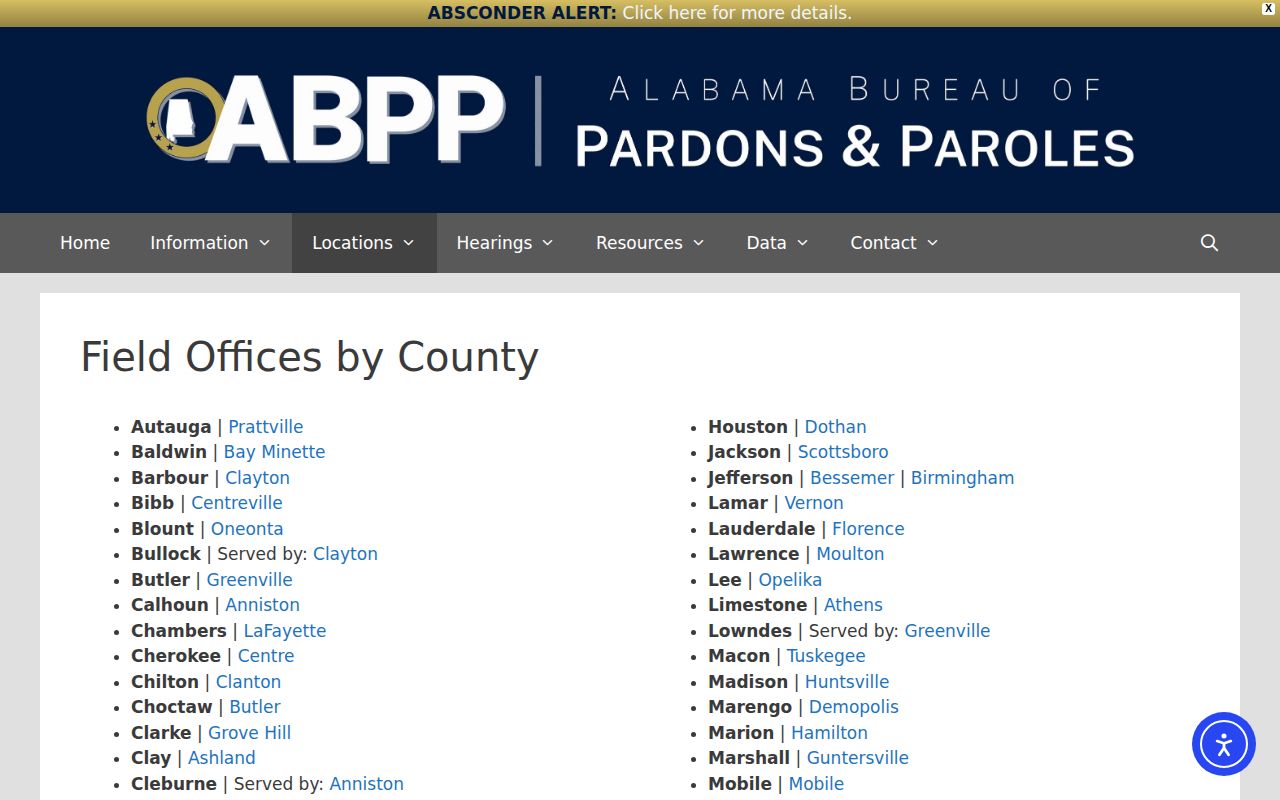
Absence from an alert list or ADOC's current prison search does not prove that parole, probation, or mandatory supervision ended.
- Parole
- Conditional release granted by the Board before the maximum term ends.
- Probation
- Court-ordered supervision that may follow or replace part of confinement.
- Mandatory supervision
- A statutory supervised period before the sentence release date for eligible prisoners.
- Discharge
- The end of the specified custody or supervision obligation, proven by the responsible agency.
Alabama VNS Release Notices
The Alabama Victim Notification System covers Alabama-convicted people sentenced to ADOC prison. A victim or concerned citizen can create an account, identify a covered offender, select notice methods, and update contact data. VNS describes notices for parole and pardon hearings, medical release, furlough, mandatory release to supervision, custody changes, end of sentence, and death. It also defines actual Release Date, Minimum Release Date, and Mandatory Release to Supervision as distinct fields.
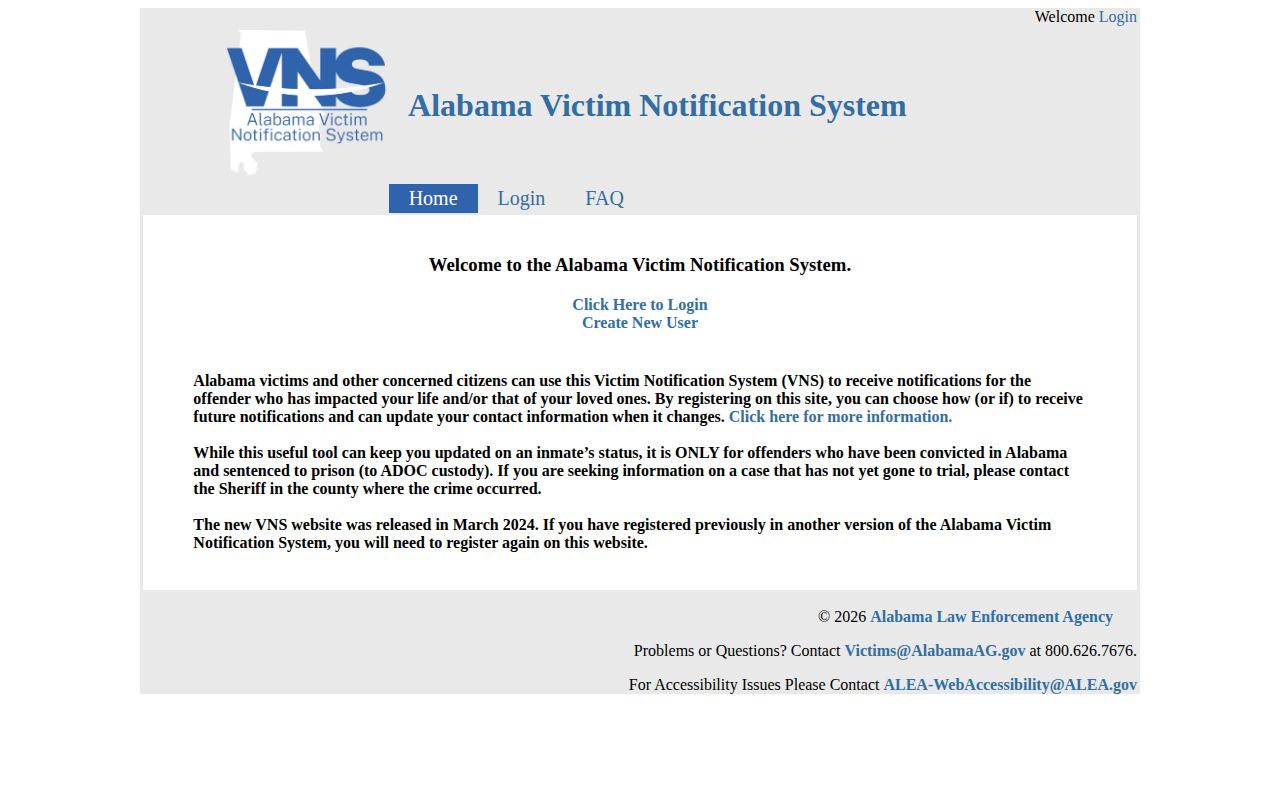
The service does not cover every county pretrial detainee; its home page directs those questions to the sheriff where the crime occurred.
The VNS registration FAQ explains the covered fields and notice choices.
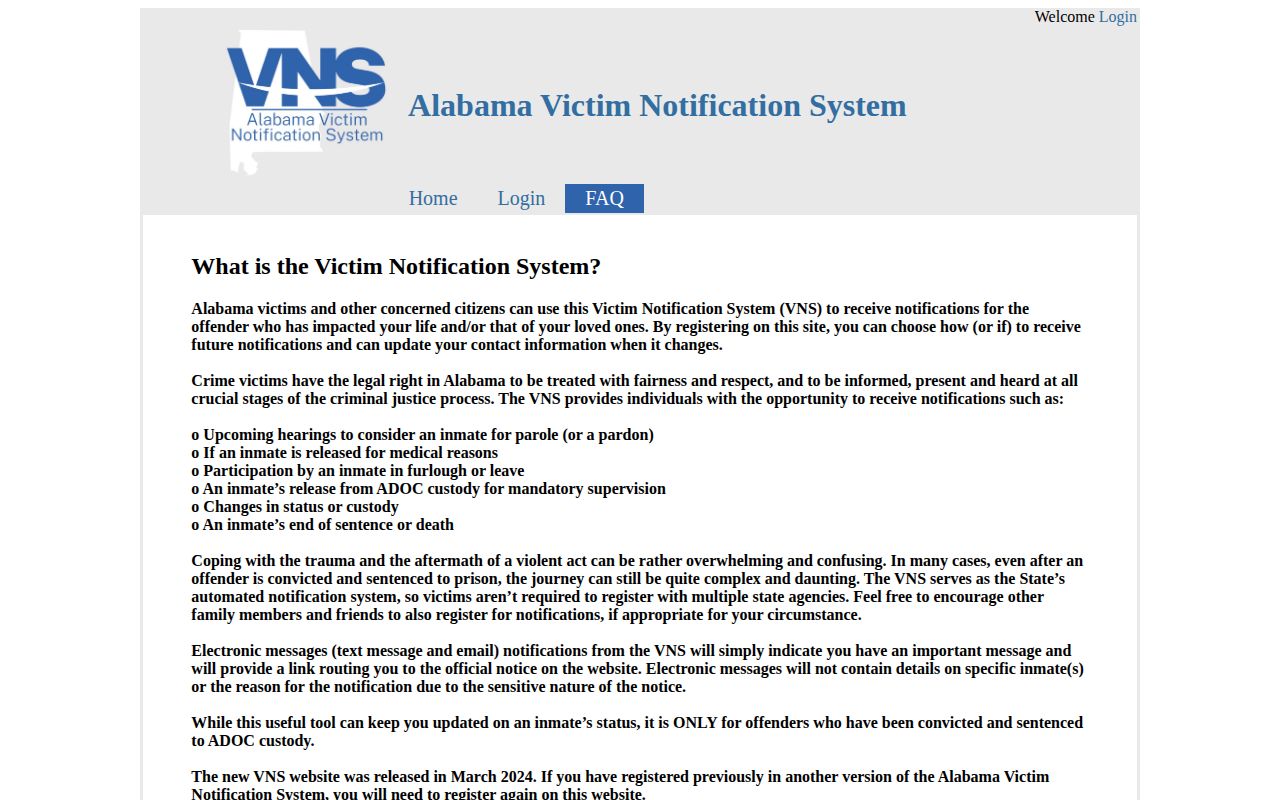
A replacement VNS launched in March 2024, and people registered in the prior version had to register again.
Federal Releases in Alabama
Federal custody requires a federal source. The BOP locator searches records from 1982 forward by federal identifier or name, with optional demographic fields. Its results show a release date and location. “Released” or “Not in BOP Custody” means the person is no longer held by BOP, but another jurisdiction or a federal supervision term may still apply. A changed sentence or credit calculation can also change a projected federal date.
The BOP inmate locator is the official federal custody route.
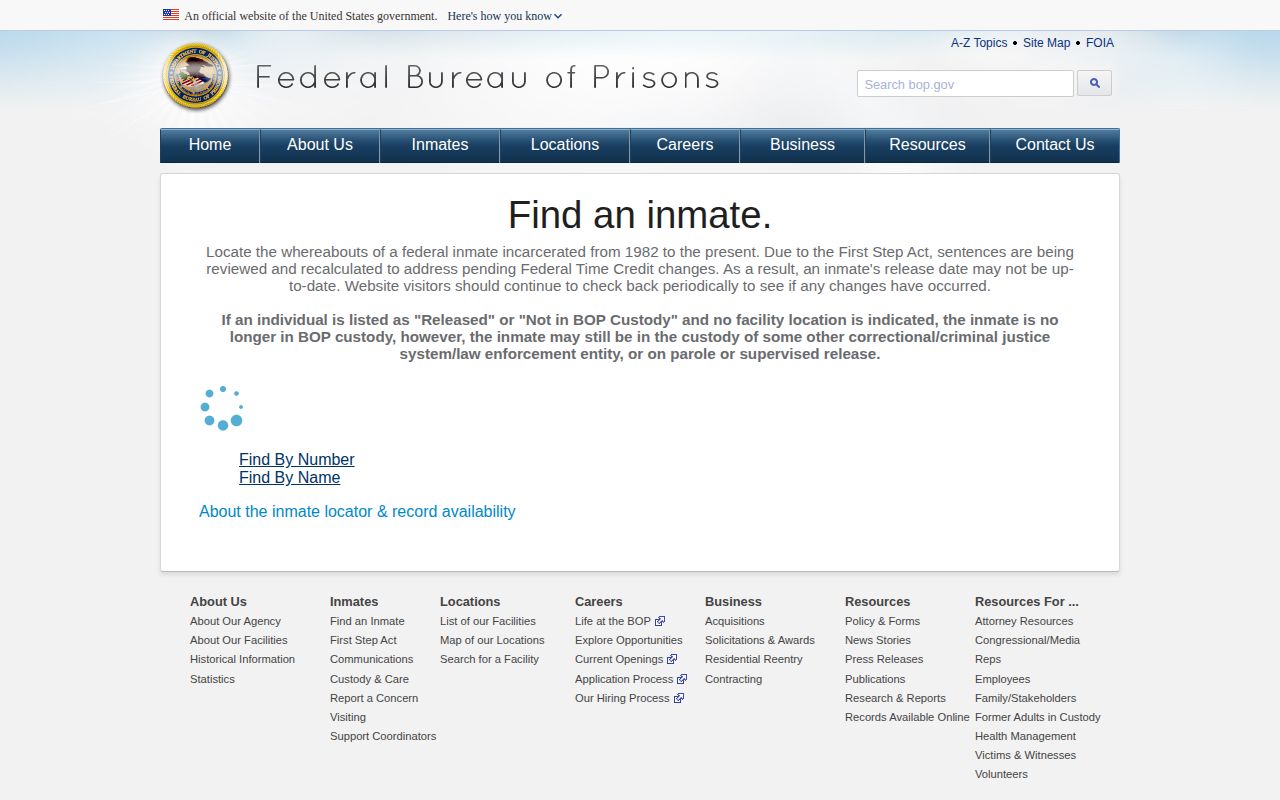
Use the register number when known, then read the status as a BOP fact rather than a statement about all custody.
ICE's Online Detainee Locator covers current ICE custody, CBP custody beyond 48 hours, and people released from ICE within the last 60 days. An A-number search needs nine digits and country of birth. People under 18 are excluded. A recent ICE result can document an immigration-custody exit, while no result cannot establish that the person was never detained.
Match Alabama Release Sources
The best source depends on the last confirmed custodian and the question being asked. Current rosters answer who is held now. Release records answer when custody ended at one agency. Court dockets answer why a judge acted. Parole tables answer what the Board decided. Notification systems alert registered users but do not replace certified agency documents.
| System | Still in custody | After exit |
|---|---|---|
| County sheriff or jail | Live local roster | County release record or written request |
| ADOC | Current-only inmate search | Central Records request, C-80, VNS, and ABPP as applicable |
| Alabama courts | Custody orders may appear | Disposition, sentence, probation, or amended order |
| BOP | Federal location and status | Release Date and Released or Not in BOP Custody status |
| ICE | Current locator coverage | Recent-release coverage for up to 60 days |
Record the source, access date, identifier, and exact status language. That small audit trail keeps an Alabama released-inmate search from turning a changing database result into an unsupported conclusion.