
Alabama Projected Versus Actual Release
ADOC defines Minimum Release Date as the earliest scheduled date a prisoner can be released to probation or at the end of sentence. It is an administrative calculation based on information then in the file. A later disciplinary action, new case, amended sentence, or other official input can move it. Actual Release Date is a completed event. Alabama VNS uses that label for the date a covered person was released from ADOC custody.
Other labels answer different questions. Mandatory Release to Supervision is a projected move from prison custody into ABPP supervision under Alabama law. Parole Consideration Date is a tentative date connected to Board processing. A grant still is not a physical exit. Home-plan review and coordination between ABPP and ADOC may follow before release.
The official ADOC definitions are the source for these labels, though the definitions page itself was not captured successfully.
The available ADOC home-page capture still identifies the corrections source responsible for Alabama state-prison data.

Use the agency's terms exactly, since changing “minimum” to “final” creates a claim the underlying record does not support.
Find an Alabama Release Date
The general ADOC search is limited to currently incarcerated inmates. That means timing matters. Check it before the projected date, while the profile may still be public, and save the AIS number and each date label. A six-digit AIS gives an exact-match search. Name fields are open-ended, capped at 50 results, and may require spelling checks.
- Identify whether the person is in ADOC, a county jail, federal custody, or immigration custody.
- For ADOC, search by six-digit AIS when known, then confirm identity through the name, institution, offense, and sentence fields.
- Record Minimum Release Date, Parole Consideration Date, Parole Status, Good Time Received, Good Time Revoked, and Time Served by their displayed names.
- Check the sentencing order and later docket entries for a split sentence, amended transcript, or new court order.
- Recheck with the custody agency close to the expected date and seek the release record after the event.
A former prisoner's absence does not prove that the displayed date occurred. The record may have vanished because ADOC does not publish historical profiles. A transfer can also end one custody listing without community release. The deeper ADOC offender search record path explains the C-80 release receipt and Form 23-A request.
Note: Keep a dated copy of each official field because an Alabama Minimum Release Date can change or disappear from public view.
Alabama Release Date Labels
Several dates may appear around one Alabama sentence. They must remain separate. A person can reach a parole consideration point and receive a denial, continuation, or grant without leaving prison that day. Likewise, a mandatory-supervision projection is not proof that the handoff to ABPP occurred.
| Official label | Meaning | Best verification |
|---|---|---|
| Minimum Release Date | Earliest scheduled release to probation or end of sentence; changeable | Current ADOC field, then ADOC records |
| Mandatory Release to Supervision | Projected move into ABPP supervision | VNS notice plus ADOC and ABPP confirmation |
| Release Date | Actual date released from ADOC custody in VNS terminology | ADOC release record or C-80 |
| Parole Consideration Date | Tentative Board date | ABPP hearing schedule and result |
| Parole Status | Current parole condition, including delinquent or revoked states | ABPP field office or agency record |
The Alabama VNS FAQ displays the prison-notification framework and defines its release fields.
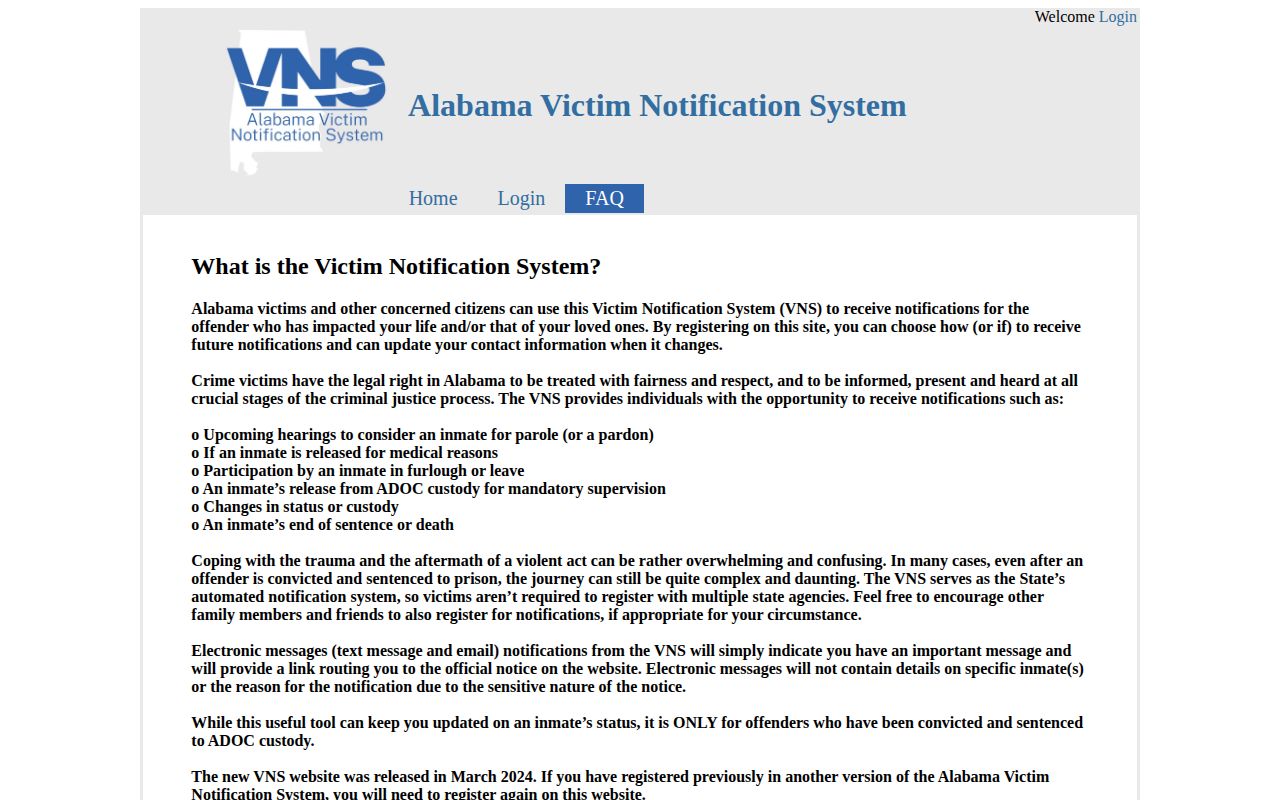
The VNS display supports notification for its covered population, but it does not replace the agency document that confirms physical release.
Alabama Good Time Release Credits
Alabama Correctional Incentive Time is governed by Ala. Code § 14-9-41. The current statute creates four earning classes. Movement through them takes time, and lower levels cannot be skipped. Classification is an official correctional decision, not a number a public user should assume from conduct or sentence length.
| Class | Credit per 30 days served | Progression rule |
|---|---|---|
| Class I | 30 days | Requires at least 12 months in Class II |
| Class II | 15 days | Requires at least six months in Class III |
| Class III | Five days | Requires at least three months in Class IV |
| Class IV | None, or flat time | Day-for-day service |
The statute excludes people serving life or death sentences, sentences longer than 15 years, Class A felonies, a deadly-weapon crime causing death, and specified child-involved sex offenses. Some assault, child-sex-abuse, and violent Class B felony convictions block Class I even when a lower class might otherwise apply. Consecutive terms combine for the calculation. For concurrent terms, the term producing the longer period controls.
Discipline may forfeit earned credit. The commissioner can restore some forfeited credit on a warden's recommendation, but the statute treats listed highest-level violations more severely. These rules explain why two people with similar sentence lengths can have different Minimum Release Dates. They do not create a reliable public calculator.
Alabama Split-Sentence Release Limits
A split sentence has a court-ordered confinement part followed by probation. Under Ala. Code § 15-18-8, the minimum confinement portion is not eligible for parole or correctional-incentive deductions. Incentive time can apply only to confinement after that minimum portion. The judgment, not a rough percentage, shows how the court structured the term.
That rule is why a sentence date and a good-time class are not enough. Jail credit, consecutive or concurrent terms, the set confinement portion, and later orders all matter. The Alabama court docket should be checked for the judgment and any amendment. ADOC must then calculate from the official papers sent by the circuit clerk.
The Alabama Just One Look portal provides one-case-at-a-time trial-court access.
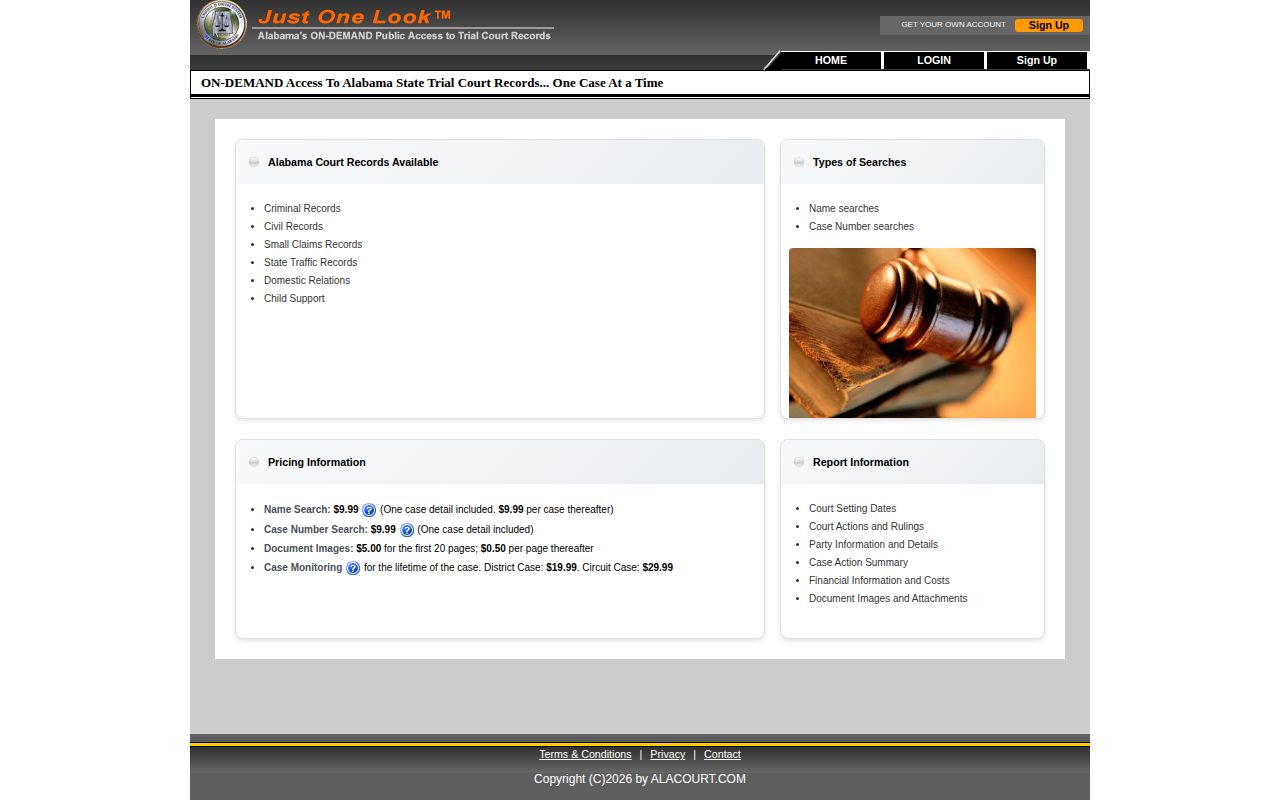
A court record can explain the sentence basis, but only the custody agency establishes when its release processing was completed.
Why Alabama Release Dates Move
The Minimum Release Date is mutable by design. ADOC says loss of good time or new cases and sentence changes sent by a circuit clerk may alter it. Regulation 628 adds the reverse situation: a spontaneous release may occur before that date after ADOC receives a court order, amended transcript, or parole-status change.
| Factor | Possible effect | Source to recheck |
|---|---|---|
| Disciplinary credit loss | Moves the projected date later | ADOC time-credit fields and records |
| Credit restoration | May move the estimate earlier | ADOC calculation |
| New or amended sentence paper | Changes the official calculation | Court docket and ADOC |
| Parole-status change | May cause an earlier spontaneous release | ABPP result and ADOC exit record |
| Detainer or pickup arrangement | Changes processing or destination | ADOC and receiving authority |
| Home-plan verification | Can delay release after a parole grant | ABPP and ADOC |
A detainer is a request or hold from another authority. It can mean that release from ADOC becomes a transfer. For that reason, “left ADOC custody” and “returned to the community” should not be treated as the same statement without destination evidence.
The ABPP current-year results show Board outcomes that may affect the path but do not certify the exit day.
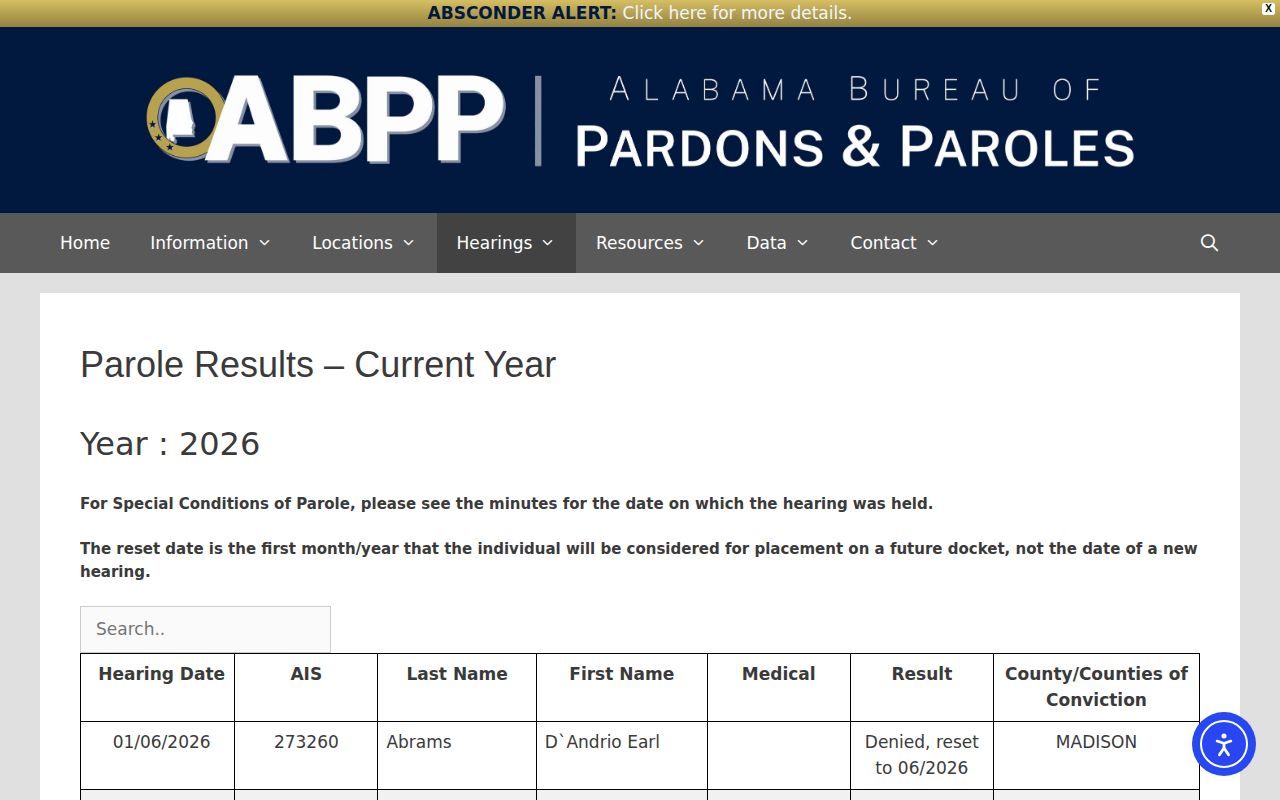
Read Granted, Denied, Denied/reset, and Continue as decision terms, then obtain separate proof of release when needed.
Alabama Mandatory Supervision Date
Section 15-22-26.2 creates mandatory release to ABPP supervision for eligible prisoners during a prescribed period before the sentence release date. Statutory exclusions and amendments apply. This is a supervised phase, not the same event as completing every correctional obligation.
VNS is the statewide prison-release notification system for people convicted in Alabama and sentenced to ADOC custody. It does not cover all county pretrial detainees. The state tells those users to contact the sheriff where the crime occurred. Thus, a VNS no-result can reflect scope rather than release.
The Alabama VNS home page states that prison-only scope and supplies registration access.
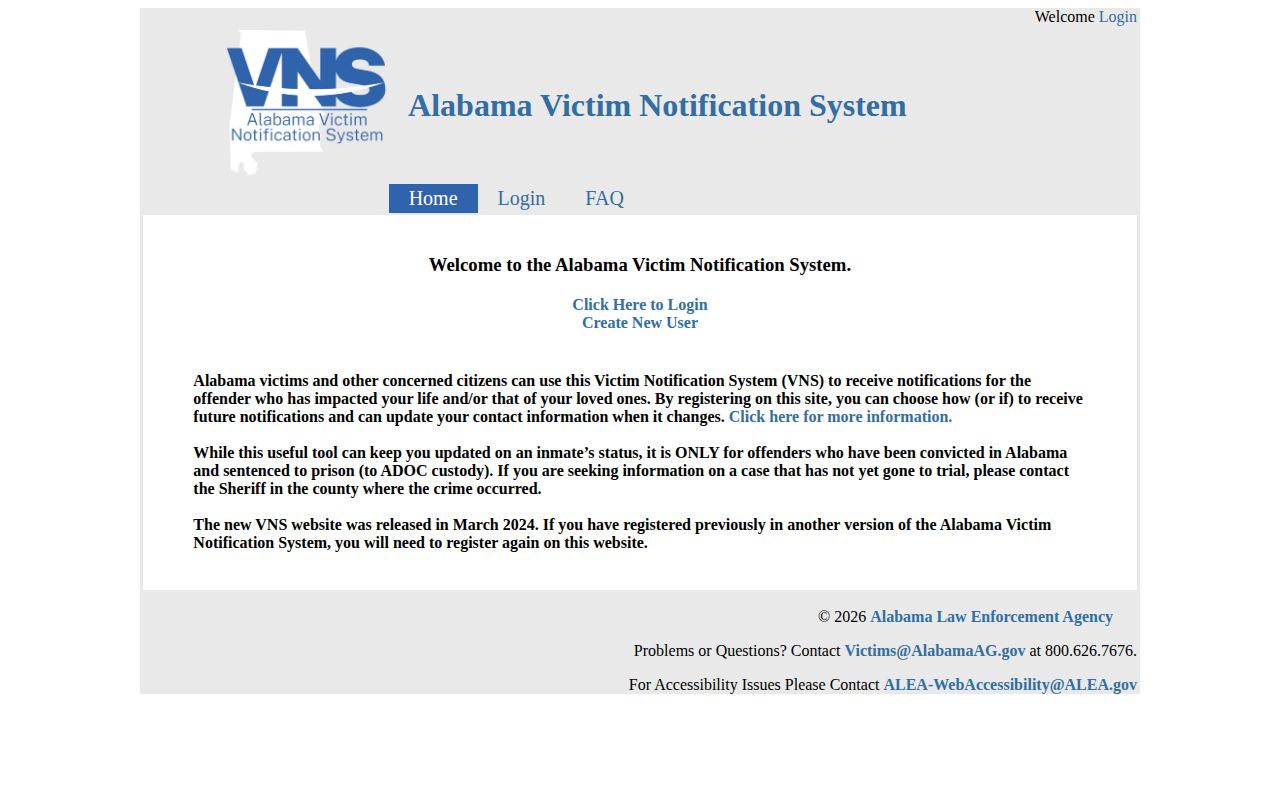
The notification view is useful for a covered ADOC case, while the release record remains the better source for a completed exit.
The system launched a replacement in March 2024 and required people registered in the prior version to register again. Keep contact details current and retain confirmation. The Alabama VINELink inmate search page details that notification route and its limits.
County Jail Projected Release Dates
A county pretrial detainee often has no fixed projected release date. Release may depend on bond, a court order, dismissal, transfer, or a later sentence. A local roster describes current custody and may remove the name after the exit. It should not be read as a historic release calendar.
For a county sentence, use the sentencing court and the jail or sheriff that computes local custody. Preserve the case number, booking number, booking date, sentence, jail credit, and any later order. County practices differ, so ADOC's six-digit AIS and Minimum Release Date do not govern every local booking.
A county roster can still help establish whether the person is listed as held at the moment checked. Yet disappearance from that roster is not a release receipt. The person may have bonded out, completed a term, transferred to ADOC, moved to another county, or entered another authority's custody. Request the local exit record when the destination and date matter. Pair it with the court order when bond, dismissal, probation, or a changed sentence is the claimed cause.
Pretrial status makes projection especially uncertain. Before judgment, there may be no sentence from which to compute good time or an end date. A hearing, payment or posting of bond, hold from another authority, or case disposition can change the path. The jail can describe custody processing, and the clerk's docket can show the judicial act. Neither should be replaced with an estimated date made from the booking day.
State-prison, county-jail, federal, and immigration dates remain separate. The BOP locator covers federal records from 1982 forward and may show a Release Date, Released, or Not in BOP Custody. ICE ODLS includes current detainees and people released from ICE within the prior 60 days. Neither system supplies an Alabama county release record.
The BOP inmate locator illustrates the distinct federal route.
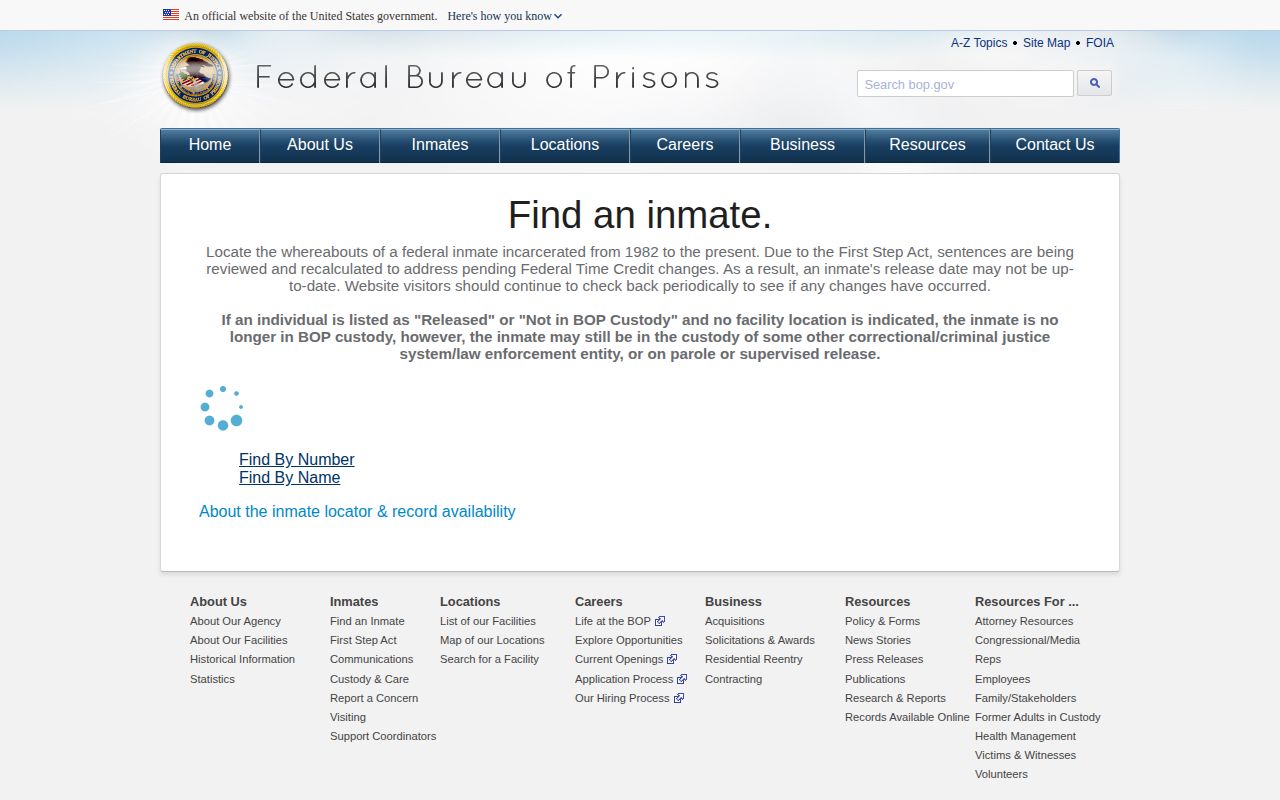
A federal result may document a federal custody exit, but it does not establish state, county, or immigration status.
Confirm Alabama Inmate Release
Near the projected date, return to the agency that holds custody. Save the current ADOC fields before they disappear. Check ABPP if parole or mandatory supervision is involved. Read the court docket when a new order may have moved the date. After the event, ask ADOC Central Records for a release record or C-80 when formal proof is needed.
Describe only what each record establishes. A Minimum Release Date is an estimate. A parole grant is a Board action. VNS is a notification source for a defined ADOC population. A court order supplies the legal cause. The dated ADOC exit record establishes state-prison release. This chain avoids the most common Alabama error: treating one projected field as a guaranteed day.
If the expected date passes while the person still appears in custody, look for a changed ADOC calculation, credit loss, detainer, new sentence paper, or delayed post-parole processing. Do not assume the system simply failed. If the name disappears before the saved minimum, Regulation 628's spontaneous-release process makes a court order, amended transcript, or parole-status change a possible explanation. Ask for the actual release record and check the receiving authority when a transfer is possible.
- Minimum Release Date
- ADOC's earliest scheduled release to probation or end of sentence, subject to change.
- Parole Consideration Date
- A tentative Board-processing date, not a promise of release.
- Spontaneous release
- An exit before the scheduled minimum because qualifying new official information reached ADOC.
- Actual Release Date
- The completed custody-exit date, confirmed through the responsible agency's record.
Note: Recheck the source close to the event and state uncertainty when no dated custody-exit document has been obtained.