
ADOC Offender Search Scope
The official ADOC Inmate Search states that its database contains only people who are currently incarcerated. Historical information is not available online. This makes it useful for one narrow question: does the public system return a person as a current Alabama state prisoner? It cannot, by itself, answer when a former prisoner left, whether the exit was parole or end of sentence, or whether supervision remains active.
Search first by the six-digit Alabama Institutional Serial number, known as an AIS number, when it is available. An AIS entry takes priority over name fields and seeks an exact match. A name search accepts first and last names separately or together, returns no more than 50 records, and sorts those results by name. The database excludes Youthful Offender Act cases. Spelling, an alias, or a missing identifier may also explain a no-result.
The ADOC home page identifies the agency and routes users into its prison information systems.

The agency home screen is a starting point, while the search limitation controls how any missing person result must be described.
Use the ADOC Offender Search
Search while the person may still be in ADOC custody. A current record may contain stable details that will no longer appear after release. Keep the exact displayed labels and the date checked. Do not turn a tentative date into an actual event or call a status “discharged” when the source does not use that term.
- Open the official ADOC inmate search and read its current-custody notice.
- Enter the six-digit AIS for an exact match. If it is unknown, try the full name and reasonable spelling variants.
- Open the matching current record and compare the name, AIS, institution, offenses, and sentence details.
- Preserve the Minimum Release Date, Parole Consideration Date, Parole Status, and time-credit labels exactly as shown.
- If no record appears, move to Central Records, ABPP, VNS, and the court as the circumstances require.
ADOC defines its date fields with care. Minimum Release Date means the earliest scheduled release to probation or end of sentence, subject to change. Parole Consideration Date is a tentative Board date, not a physical release date. Parole Status concerns parole and can show delinquency or revocation. Good Time Received, Good Time Revoked, and Time Served are distinct entries, not interchangeable labels.
Note: Save the AIS and exact field names before release, because Alabama does not keep the former prisoner's public profile online.
Verify an Alabama Prison Release
A strong check starts by naming the custody layer. An AIS points to ADOC. A county booking number belongs to a sheriff or local jail. A federal register number belongs to the Bureau of Prisons, while an A-number is used for immigration custody. Leaving one facility may mean transfer to another authority, not return to the community.
| Evidence | What it can establish | What it cannot establish alone |
|---|---|---|
| ADOC current search | Current public state-prison result and displayed fields | Historical release or discharge after the profile disappears |
| ADOC release record or C-80 | Dated state-prison exit and release paperwork | Every later supervision event |
| ABPP decision or office record | Parole decision or supervision information within agency limits | The precise moment ADOC processed the physical exit |
| Court docket or order | Judgment, sentence, amendment, or judicial cause | Actual facility processing time |
| County release record | Exit from that local jail | ADOC release from a state prison |
When two sources agree, the conclusion becomes clearer. A dated ADOC record can establish the custody exit, while an ABPP record can show parole action or the field office route. A court order may explain why the date changed. Use plain limits when evidence is incomplete: “parole granted; physical release not established,” or “county custody ended by transfer to ADOC.”
The order of checks should follow the facts already known. If an old ADOC record supplies an AIS and institution, start with Central Records and preserve that AIS in every later contact. If a parole result is the only dated item, compare its name and AIS with the ADOC identity, then ask whether release processing was completed. When a court order appears first, confirm that ADOC received and acted on it. Each record describes one link in the chain. None should be made to speak for a different agency.
A status check also needs an access date. ADOC's online population changes, ABPP results describe Board action, and VNS notices can arrive as the covered event moves through the system. A dated note lets a later reader understand why an earlier search returned a current profile while a later one did not. It also avoids treating an ordinary database update as evidence of the exact hour of release.
ADOC Release and Discharge Types
Alabama's published categories are End of Sentence, Parole Releases, Split Sentence, Mandatory Release, and Other. A parole grant is recorded separately from a parole release. That distinction matters. The Alabama Board of Pardons and Paroles may approve parole, yet ABPP still must verify the home plan and coordinate with ADOC before physical release.
Parole is discretionary conditional release under Ala. Code § 15-22-26. A parolee remains in the legal custody of the prison warden until the maximum term expires or a full pardon occurs. Mandatory release to supervision under § 15-22-26.2 likewise moves an eligible person into ABPP supervision before the sentence release date. It is not the same as full discharge.
A split sentence combines a court-set custody portion with probation. End of sentence records completion of the custodial sentence category, after which the current ADOC web profile disappears. “Other” is an official statistical group, not a basis for guessing. ADOC Regulation 628 also defines spontaneous release, an earlier exit caused by a court order, amended transcript, or parole-status change received before the scheduled Minimum Release Date.
Good time affects calculation but does not replace the release category. Alabama Correctional Incentive Time under Ala. Code § 14-9-41 uses four earning classes, exclusions, and forfeiture rules. The court-set minimum confinement in a split sentence has its own limit under § 15-18-8. Detainers, warrants, and pickup arrangements may then affect the exit destination. The correct description comes from the final record, not a calculation made from sentence length.
Alabama C-80 Release Receipt
Alabama gives its release paper trail a specific name. Under ADOC Administrative Regulation 411, Form CREC 047 is the Receipt of Released Convict, commonly called the C-80. The released person and two witnesses sign it, and the person receives a copy. A facility may not release the person before it receives the C-80 and any required parole certificate, or before the effective date shown on those papers.
Parole cases may add a parole certificate, waiver of extradition, and compact-services application. ADOC's pre-release work applies to people nearing anticipated parole, end of sentence, or split-sentence probation. Its exit packet describes parole papers, a bus ticket, identity verification, and clothing. Staff also check warrants and detainers. No reviewed official source sets one fixed Alabama cash gate-money amount, so no such amount should be inferred.
- C-80
- The signed Alabama receipt documenting release from ADOC custody.
- Detainer
- A request or hold from another authority that may change where a person goes after ADOC processing.
- Discharge
- The end of a custody or supervision obligation, which must be tied to the agency record using that term.
- Mandatory supervision
- A statutory period of ABPP supervision before the sentence release date for an eligible prisoner.
The Alabama VNS notification FAQ distinguishes projected mandatory supervision from an actual Release Date.
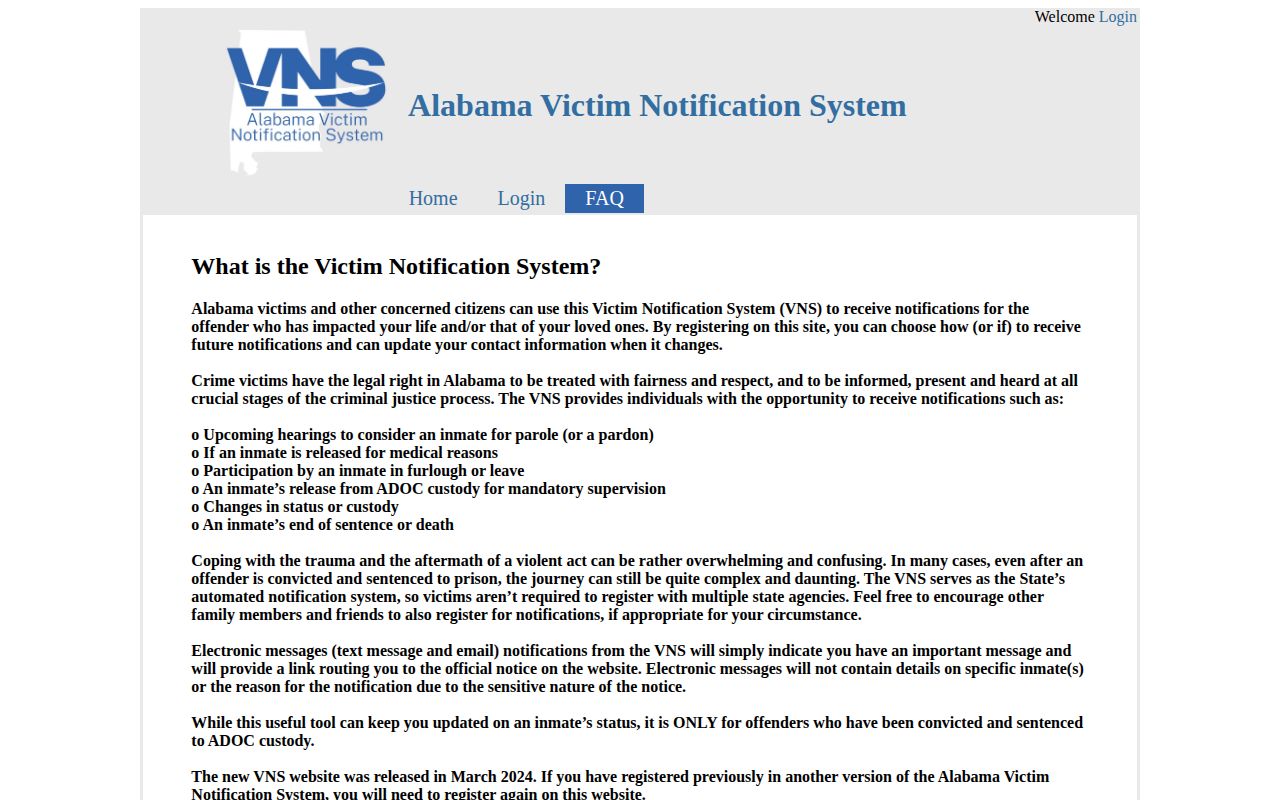
The VNS terms help keep notification data separate from the signed ADOC release receipt and final agency record.
Alabama ADOC Release Counts
ADOC's April 2026 monthly report recorded 874 jurisdictional release events. The categories were 108 end of sentence, 102 parole releases, 326 split sentence, 157 mandatory release, and 181 other. It also reported 411 releases from ADOC custody. The separate parole line showed 65 grants, which ADOC excludes from release totals.
| Measure | April 2025 | April 2026 |
|---|---|---|
| Jurisdictional releases | 843 | 874 |
| Releases from ADOC custody | 400 | 411 |
| Parole releases | 82 | 102 |
| End of sentence | 119 | 108 |
| Mandatory release | 163 | 157 |
The single-month comparison rose modestly, yet the fiscal-year picture differed. Through seven months of FY2026, ADOC counted 5,487 jurisdictional releases, 2,385 releases from its custody, and 395 parole releases. Comparable fiscal-year totals were below the prior year, while jurisdictional population rose from 27,569 to 28,568. ADOC also allows 30 days after month-end for admissions and release processing, so the report date and measurement rule belong with every trend claim.
The ABPP current-year results table documents Board outcomes rather than ADOC release events.
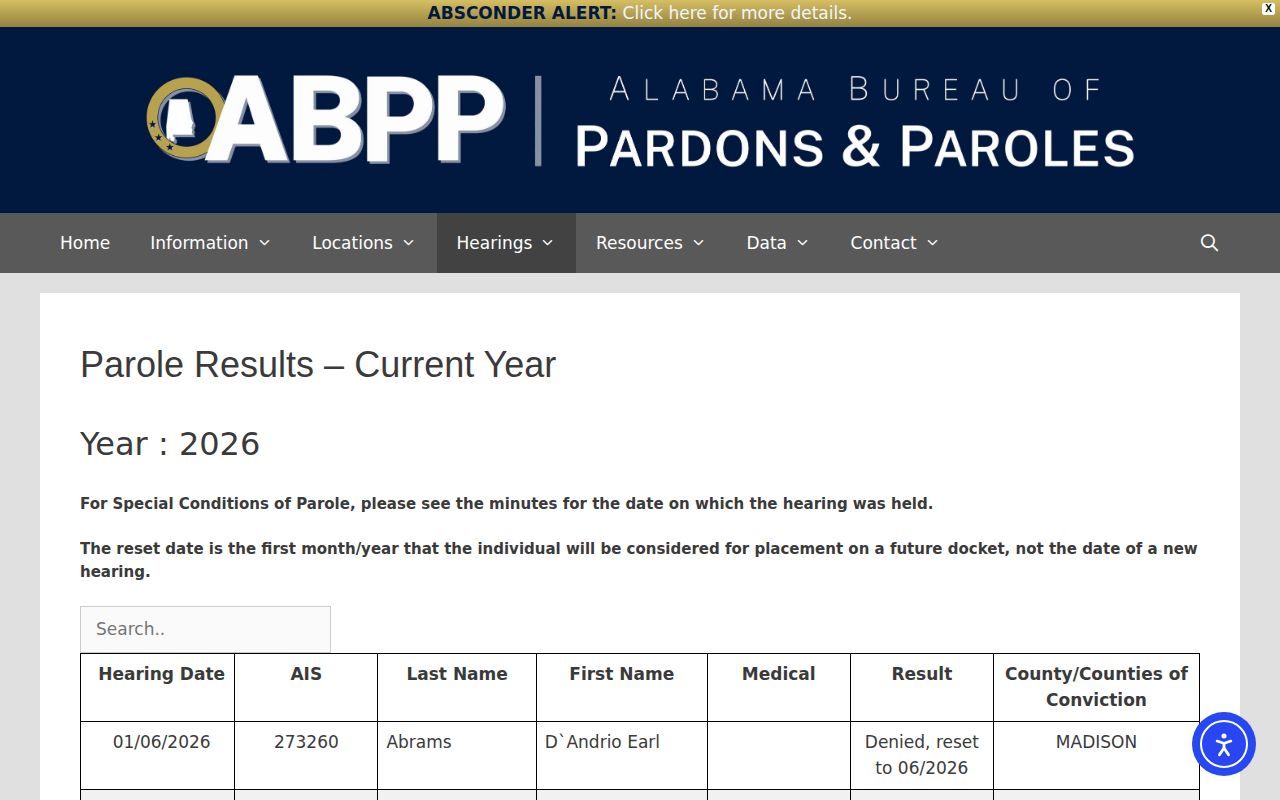
A favorable result should be paired with ADOC evidence before stating that an Alabama prisoner actually left custody.
Request ADOC Release Records
A released person often requires a written request because the general ADOC offender search has no historical profile. ADOC uses Form 23-A and states that records are available to people permanently domiciled in Alabama, subject to law, exemptions, and prepayment. The form carries a nonrefundable $20 processing fee.
Form 23-A asks for requester contact details and Alabama-residency attestation. It also asks for the person's name, AIS and date of birth, a specific record description, a purpose-neutral proposed use, the desired paper, electronic, or inspection format, and whether certification is requested. Send public-record inquiries to `public.records@doc.alabama.gov`, call 334-353-3883, or mail the Public Records Coordinator at Alabama Department of Corrections, P.O. Box 301501, Montgomery, AL 36130-1501.
- Identify the person by full name, AIS if known, and date of birth.
- Give a narrow custody or release date range and name the existing document sought.
- Ask for releasable release date, type, last ADOC location, and C-80 or other release paper.
- Select the format and certification choice, complete the residency statement, and submit the fee as directed.
- Read any redaction or denial against the cited exemption rather than assuming the full central file is public.
Controlled, confidential, privileged, and nonpublic records may be withheld or redacted. ADOC need not create a new record. The request should also distinguish a community release from transfer to another authority. Constituent Services routes individual-inmate questions, while Central Records is listed at 334-353-9738.
Alabama's general Public Records Law sits at Ala. Code §§ 36-12-40 through -47. Act 2024-278, effective October 1, 2024, formalized standard and time-intensive request tracks for Alabama residents. It allows a custodian to require a specific written request and does not force an agency to answer a vague, overbroad, ambiguous, or unreasonable demand. Clarification can restart the response timing. Prepayment, lawful fees, exemptions, privilege, and confidentiality still apply.
A request for an existing release document fits that structure better than a demand that ADOC prepare a new account of the case. Give a useful date span. Name the C-80 when that is the paper sought. If the requested category is withheld, the response may identify the rule that controls. Law-enforcement investigative reports and material have separate nonpublic treatment under § 12-21-3.1, so a releasable custody-exit record does not make the whole correctional or investigative file open.
Certification is also a distinct choice on Form 23-A. Select it only when a certified copy is needed for the purpose at hand, and expect the agency to apply its own process. An electronic copy, paper copy, or inspection request may involve different handling. The most useful response is the one tied to a named person, stable AIS, clear record type, and narrow period.
ADOC Release Cross-Checks
Alabama VNS covers Alabama-convicted people sentenced to ADOC prison. It is not a universal county-jail search and not a certified release record. ABPP supplies parole results and county field-office routes. Alabama trial-court records can show the sentence, amended order, probation order, or revocation that explains a change, but the court docket does not prove the moment a prison processed release.
The Alabama Just One Look portal offers state trial-court case access one case at a time.
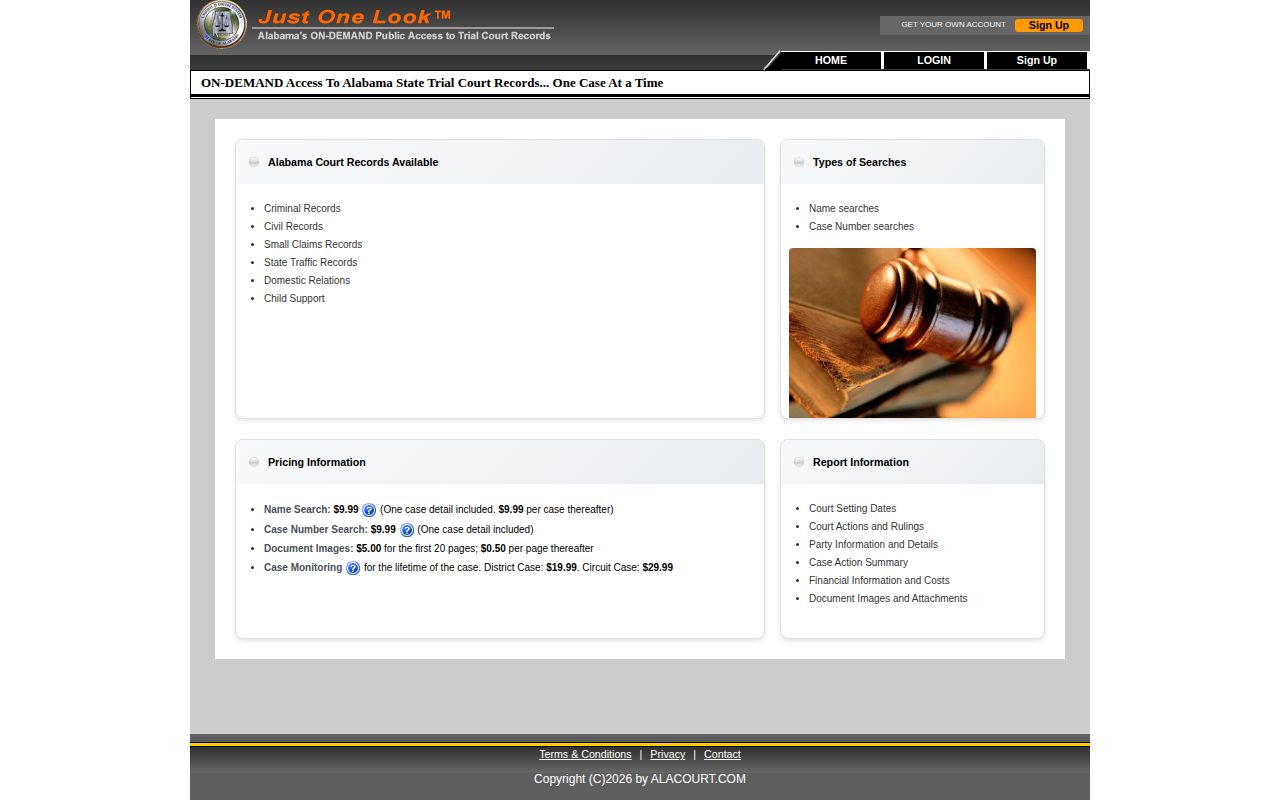
Match a court order to the custody record when a sentence amendment or other judicial event may have moved the release date.
Federal and immigration systems remain separate. Use the BOP locator for federal prisoners and the ICE locator for immigration custody. The BOP result may show Released or Not in BOP Custody and a release date, but that does not rule out another authority or later supervision. ICE can return current detainees and people released from ICE within the last 60 days. Neither source confirms an ADOC exit.
ADOC Versus County Release Records
ADOC prisons, work centers, and community-based facilities remain state custody even when they sit within a county. Their exits route through ADOC records, VNS, and ABPP. County jails hold local bookings, many pretrial detainees, short sentences, and transfers. Their live rosters often remove a person after release, so the sheriff or local jail holds the relevant exit record.
| Custody layer | Stable clue | Release source |
|---|---|---|
| Alabama state prison | Six-digit AIS | ADOC Central Records and C-80 |
| County or municipal jail | Booking number and booking date | Releasing sheriff, jail, or municipal custodian |
| Federal prison | Federal register number | BOP locator and responsible federal office |
| Immigration custody | Nine-digit A-number and country of birth | ICE ODLS and responsible ICE office |
The statewide County Directory routes local jail questions to the county that created the booking and release record. That source is more precise than trying to force a local detainee into the ADOC offender search.
Note: Off one roster can mean transfer, so name the receiving authority whenever the source records one.